
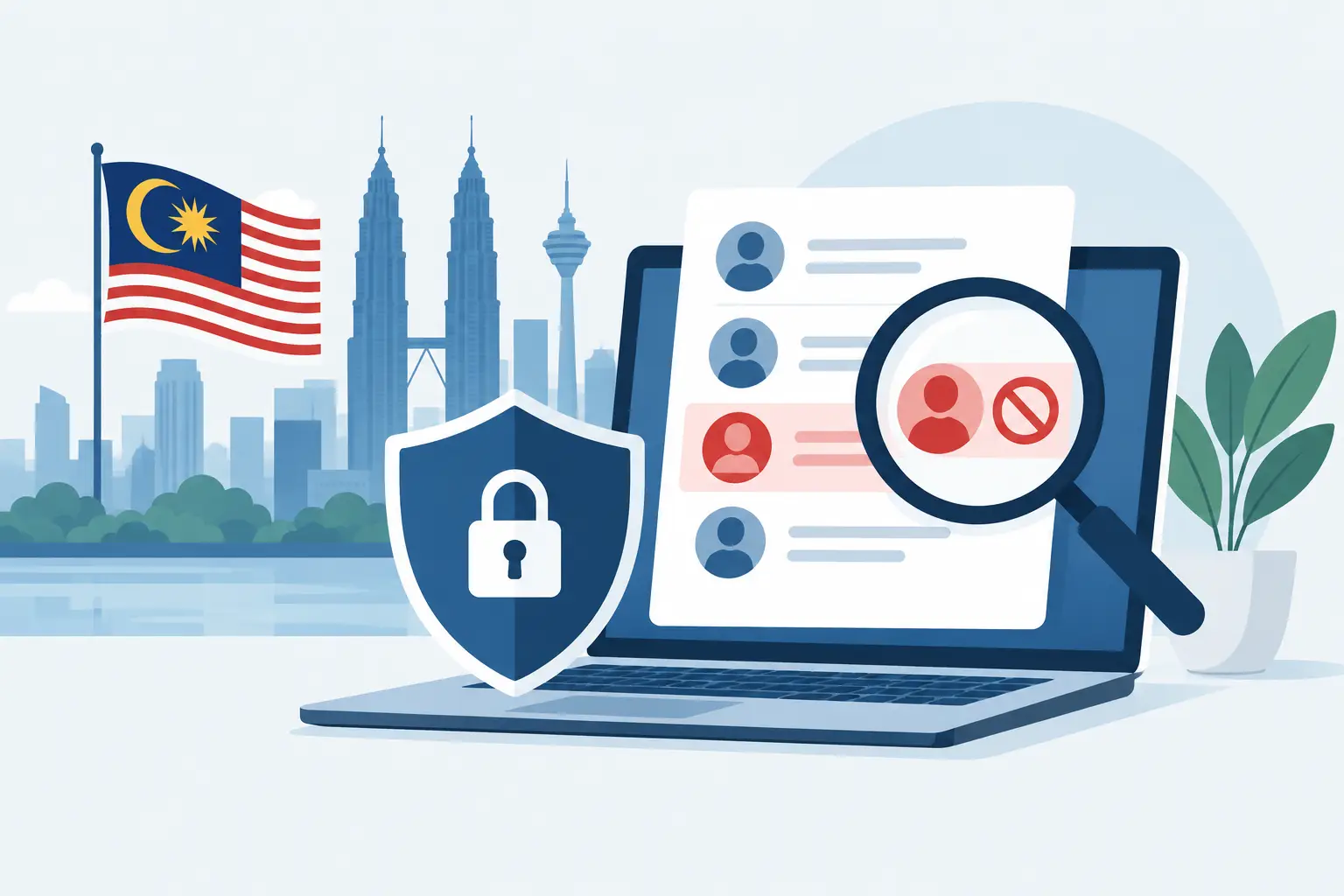
A candidate may present strong experience, valid-looking qualifications and persuasive references, yet still carry a regulatory history that changes the risk profile of an appointment. Regulatory blacklist screening Malaysia gives employers and commercial decision-makers a structured way to identify whether a person or organisation appears on relevant regulatory, enforcement or exclusion records before authority, access or funds are placed in their hands.
For an employer, this is not about treating every alert as proof of wrongdoing. It is about identifying information that must be reviewed before a hiring, directorship, tenancy, credit or partnership decision becomes expensive to reverse. A properly handled result supports a fair, documented and defensible decision rather than a rushed judgement based on incomplete information.
What regulatory blacklist screening is designed to identify
Regulatory blacklist screening checks whether an individual or business is associated with relevant regulatory restrictions, warnings, enforcement actions, debarments or exclusion lists. The precise sources and relevance will depend on the role, industry and purpose of the screening engagement.
For example, a financial-services appointment, a procurement supplier, a company director and a tenant seeking access to a high-value commercial site do not create the same exposure. The screening scope should reflect the authority the person will hold, the assets they can access and the harm that may follow if adverse information is missed.
In practice, a regulatory screening review may help identify concerns such as restrictions on acting in regulated capacities, adverse regulatory findings, disqualification-related issues, public enforcement notices, or records indicating that additional due diligence is required. It can also reveal name similarities that need to be resolved before a decision is made.
That final point matters. A name match is not automatically a confirmed match. Common names, changes in spelling, differing transliterations and incomplete identifying details can all produce misleading results. Professional screening must therefore distinguish a potential alert from a verified finding.
Why Malaysian businesses use regulatory blacklist screening
The cost of an unsuitable appointment is rarely limited to recruitment fees. A hire with undisclosed regulatory concerns may expose an organisation to fraud, mishandled customer information, procurement irregularities, conflict of interest, financial loss or reputational damage. Where the individual is a director, authorised signatory, finance employee, sales agent or senior operational leader, the consequences can extend well beyond one department.
The same principle applies to commercial relationships. Before appointing a distributor, entering a joint venture, approving a tenant, extending credit or engaging a contractor, decision-makers need credible facts about the parties involved. Regulatory information can help reveal whether a proposed relationship deserves further investigation, tighter contractual safeguards or a decision not to proceed.
Screening is particularly valuable where a role involves one or more of the following: control over payments, access to sensitive systems, responsibility for regulatory compliance, contact with vulnerable customers, authority to bind the company, or unsupervised access to stock and premises. In these situations, relying solely on a CV, interview and references leaves a clear gap in risk control.
Screening should be proportionate to the decision
There is no single blacklist check that answers every risk question. Effective screening starts by defining the decision at hand and the risks that are reasonably connected to it.
A junior office role may require a different level of review from a chief financial officer appointment. A business seeking a tenant for a residential property will assess different concerns from an insurer reviewing a claim or a company assessing a joint-venture partner. Over-screening can create unnecessary delay and privacy risk, while under-screening can leave serious issues undiscovered.
A proportionate programme considers the person’s proposed duties, seniority, access to money or assets, the sector in which the business operates, and any regulatory obligations affecting the organisation. It should also consider whether screening is being conducted before appointment, periodically during employment, or following a specific concern such as an allegation, unexplained loss or conflict-of-interest disclosure.
For high-consequence roles, regulatory blacklist screening is commonly used alongside identity verification, employment verification, qualification checks, reference checks, civil litigation checks, criminal record screening where lawful and appropriate, financial-probity reviews, directorship checks and business due diligence. Each check answers a different question. Together, they provide a clearer basis for action.
What a responsible screening process looks like
A useful report is not simply a database search result. It is a controlled process that begins with accurate identity details and a clear lawful purpose. Without sufficient identifiers, the risk of confusing one person with another rises sharply.
The screening provider should then assess relevant records against the agreed scope, document the basis of any potential match and carry out appropriate verification. Where an alert is found, the report should explain what has been identified, the source category, the degree of confidence in the match and any limitation that the decision-maker should understand.
The organisation receiving the report must then assess relevance. An old or unrelated matter may not justify rejecting a candidate or commercial party. Equally, a recent, verified restriction that is directly connected to the proposed role may require immediate escalation. Context is essential: the nature of the record, the level of responsibility involved and the safeguards available all affect the appropriate response.
This approach also protects organisations from making decisions based on rumour, internet speculation or unverified allegations. A defensible screening process is evidence-led, confidential and consistent.
Privacy, fairness and confidentiality are part of risk control
Background screening involves personal and commercially sensitive information. It should be conducted only for a legitimate business purpose, using information that is relevant to that purpose and managed with appropriate confidentiality.
Employers and businesses should be transparent about their screening process, obtain consent or provide notice where required, and limit access to those who need the information to make or oversee the decision. Reports should not be circulated casually or retained indefinitely merely because they may be useful later.
Fairness is equally important when an adverse result appears. Before taking action, organisations should confirm that the record relates to the correct person or entity, consider any explanation or updated information, and apply the same decision standards consistently. A screening report informs a decision; it should not replace sound judgement, internal policy or legal advice where specialist interpretation is needed.
For regulated sectors or sensitive appointments, a written escalation process is valuable. It clarifies who reviews the finding, when additional evidence is needed, whether the candidate or party is asked for clarification, and who has authority to approve exceptions. This reduces the chance of inconsistent treatment between departments or locations.
Common weaknesses that leave exposure behind
The most common weakness is treating screening as a one-time administrative exercise. A clean result at hiring does not guarantee that risk will not emerge later. Changes in directorships, financial pressure, misconduct allegations, regulatory action or undisclosed outside interests can alter the risk position during employment or a commercial relationship.
Another weakness is relying on a basic name search with no identity resolution. This can produce false positives that unfairly affect an individual, or false reassurance where the correct record is missed. Accurate identity data and careful verification are central to meaningful results.
Businesses also create avoidable exposure when they apply the same screening package to every role. A standard process can be efficient, but it must allow enhanced due diligence for senior leaders, finance roles, procurement teams, high-trust positions and high-value commercial relationships.
Finally, screening findings often fail to reach the right person. If HR, compliance, procurement, legal and operational leaders work in isolation, material risk information may be reviewed too late. Clear reporting lines and decision ownership turn screening from a report into a practical control.
When an alert is identified
A verified alert should trigger a measured assessment, not an automatic outcome. First, confirm identity and the current status of the record. Next, consider whether it is relevant to the proposed role or transaction, whether it creates a legal or policy barrier, and whether reasonable safeguards could manage the exposure.
For example, a concern linked to financial integrity carries greater weight for a role approving payments than for a position with no financial authority. A prospective director or business partner requires a broader review because their conduct may affect corporate governance, stakeholder confidence and the organisation’s reputation.
Documenting the reasoning is as important as documenting the finding. If the organisation proceeds, the record should show why the risk was considered acceptable and what controls apply. If it declines, the decision should be based on relevant, verified information and a consistent internal process.
Angel Checks supports organisations that need confidential, decision-ready intelligence before they appoint, approve or engage. The objective is straightforward: provide accurate findings that help businesses protect people, assets, operations and reputation without losing sight of fairness and lawful practice.
The strongest screening decisions are made before access is granted, contracts are signed or authority is delegated. When the stakes are high, a proportionate regulatory review gives decision-makers the facts needed to act with greater confidence and care.










Leave A Comment